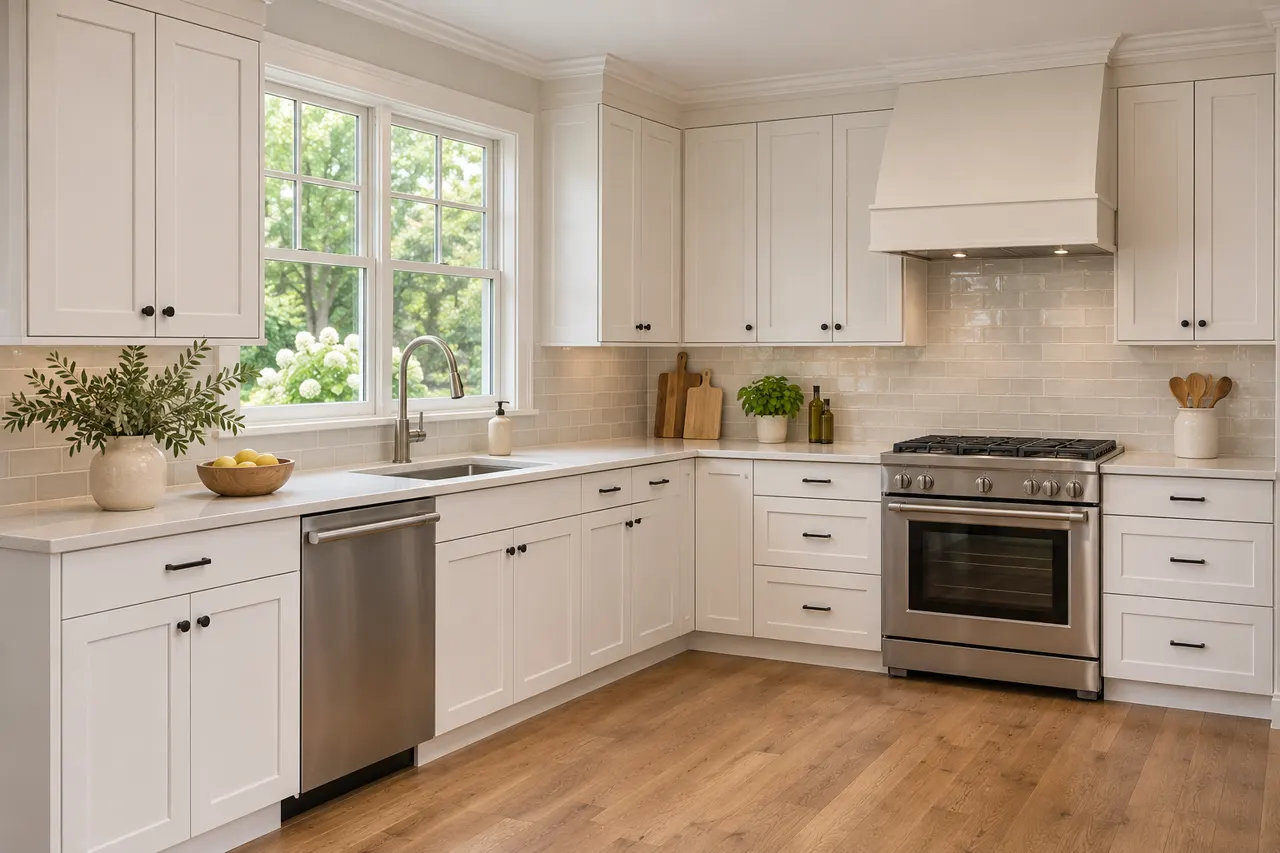
Treat glass-front sections as a storage choice
A glass-front cabinet makes its contents visible. Decide what will be displayed and what belongs behind a closed Shaker door.
If the current cabinet boxes will remain, their suitability needs assessment before replacement fronts are ordered. Existing hinge positions and dimensions may affect the proposal. Keep a front-only quotation separate from a complete cabinet replacement so the apparent similarity of the finished room does not hide a different scope.
- Contents: Choose the visible pieces.
- Interior: Review shelves and internal appearance.
- Access: Check how the displayed items are reached.
A display section can add interest but reduces concealed storage. Keep its size connected to the objects you actually want on view. Specify the glass-front units and their internal finishes separately.
Distinguish new cabinets from replacement fronts
Changing fronts and replacing cabinet boxes are different projects. Identify which parts are retained before comparing a Shaker proposal.
Two doors can have a similar framed appearance while using different materials or construction. Request the actual product description alongside the finish sample. Compare the same details across quotations so a preferred photograph does not become a substitute for deciding what will be supplied.
- Existing boxes: Record what may stay.
- Hardware: Identify retained or new fittings.
- Interiors: Note storage changes under consideration.
A new front does not by itself change the cabinet interior or layout. Confirm which practical improvements the proposed work includes. State whether the order includes fronts, cabinet boxes, interiors or a combination.
Use the front schedule to prevent assumptions
A kitchen may contain several door and drawer sizes behind one finish name. Check that the order describes each front group.
Ask the proposal to distinguish complete cabinets, replacement doors, exposed panels and fitting. Those packages can all be described loosely as a Shaker kitchen. Naming each part helps you compare the work you want without assuming that every offer covers the same replacement boundary.
- Schedule: Review the front quantities.
- Sizes: Match them to the cabinet plan.
- Options: Identify decorative additions separately.
A single overall rendering helps explain the kitchen but may not establish every front product. The schedule should make the supplied package reviewable. Reconcile the door and drawer list with the approved cabinet elevation.
Review the frame proportions on the actual doors
Shaker fronts combine a frame with a recessed panel. The proportions need to be considered on the proposed door and drawer sizes rather than one sample alone.
Place the sample at the cabinet's intended height and beside the retained surfaces. A narrow frame and a broader one can read differently across a whole wall. Record the profile as well as the color; the word Shaker does not identify a particular door product.
- Door sizes: Compare smaller and taller fronts.
- Drawers: Review the proposed front pattern.
- Alignment: Look at adjoining units together.
A frame that looks balanced on a tall door may occupy more of a small drawer front. Compare the complete elevation before choosing the profile. Identify the door profile and the proposed front arrangement in the order.
Keep the recessed panel practical to maintain
Ask for the care information for the actual door finish. The profile and hardware create surfaces that should suit the way the kitchen is used.
Ask what happens where the cabinet run meets the ceiling or an existing trim detail. Decorative finishing changes the elevation and adds components to the order. Decide whether you want that treatment before comparing totals that might include different upper finishing arrangements.
- Product: Confirm the supplied finish.
- Care: Request its maintenance directions.
- Details: Review corners and exposed edges on a sample.
A more detailed profile and a simpler frame have different visual effects. Compare that choice with the cleaning routine you are prepared to follow. Have the product care information accompany the final door specification.
Review the corner where framed fronts meet
The front profile and handles need space to operate at a junction. Show the adjoining doors and drawers together.
Handle placement deserves review across the entire kitchen, including drawers and tall cupboards. A position that looks balanced on one front may feel awkward on another. Mark the intended locations before fitting so the approved arrangement can be checked consistently against the drawing.
- Corner: Record the cabinet junction.
- Handles: Review their projection.
- Opening: Check the neighboring door travel.
A tidy closed elevation can conceal an awkward opening sequence. Resolve access alongside the visual alignment. Include the corner arrangement and any required fillers in the cabinet drawing.