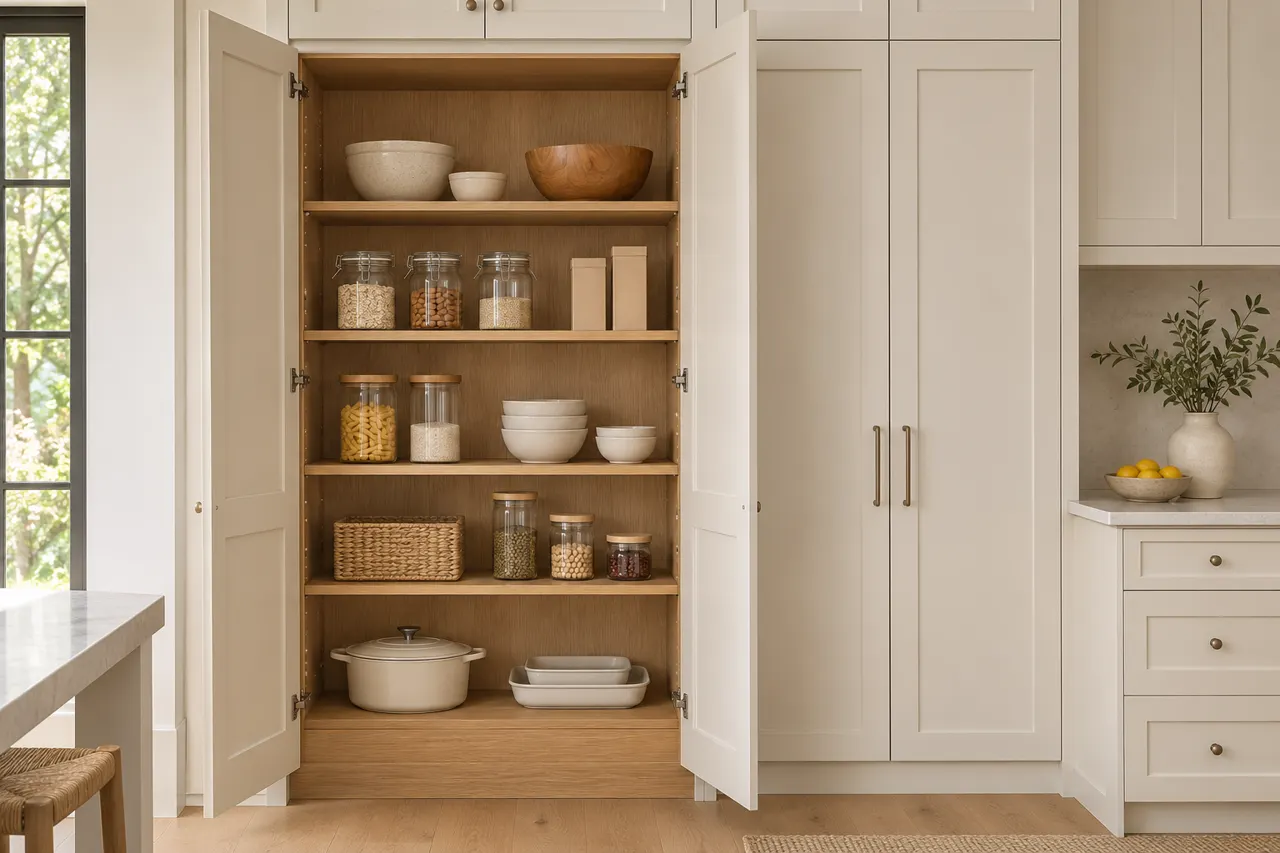
Choose shelf depth from the food packages
Short jars and larger containers need different visibility and removal space. Compare their dimensions before repeating one depth through a tall pantry unit.
Try the shelf arrangement with a short jar, a cereal container and the largest reserve package you regularly buy. These objects reveal different visibility problems. A deeper cabinet can hold more volume while leaving everyday ingredients harder to identify, especially when smaller packages migrate behind taller ones.
- Packages: Measure representative containers.
- Visibility: Check which items disappear at the back.
- Access: Review how the contents are removed.
Deeper shelving adds volume but may hide smaller packages. A mix of depths can be worth discussing where the cabinet construction allows it. Identify the proposed pantry depths and intended food groups.
Compare shelves with pantry pull-outs
A pull-out brings contents forward but uses hardware and space differently from an ordinary shelf. Compare the two using the same grocery groups.
Compare the proposed pull-out with an ordinary shelf using the same grocery inventory. Note how much usable space the mechanism occupies and what moves together. Request the named hardware, its intended application and the complete cabinet arrangement rather than choosing an accessory solely because it appears in a demonstration.
- Contents: Name the packages to be stored.
- Movement: Review the pull-out travel.
- Product: Request the actual fitting specification.
A pull-out is useful when its accessible contents justify the proposed arrangement. It is not an automatic improvement in every pantry bay. List pull-out products and quantities separately from ordinary shelving.
Follow the food preparation groups
A pantry can be organized around breakfast, baking or regular meal preparation. Describe those groups before allocating shelves.
Follow a familiar routine such as making breakfast or preparing a baking recipe. Identify the ingredients used together and the surface where they are measured. That sequence gives the pantry layout a more useful basis than grouping every package only by its shape or height.
- Routine: Name the preparation task.
- Ingredients: List the supplies it uses.
- Return: Discuss where opened packages go back.
Grouping by package size and grouping by use lead to different arrangements. Compare both when deciding which contents should stay together. State the food groups that the pantry layout is intended to support.
Choose the pantry interior product as well as the front
The cabinet exterior does not describe its shelves, surfaces or edges. Review the interior specification alongside the door finish.
Ask for the shelf product, internal surface and exposed edge details alongside the door sample. A front finish does not describe the cabinet interior. Keep the supplied care information with the product references so the pantry can be reviewed as a complete package rather than an attractive elevation.
- Shelves: Request the proposed product.
- Surface: Review the internal finish.
- Care: Ask for the relevant maintenance information.
A coordinated front palette can contain different interior products. The order should identify what is supplied inside as clearly as outside. Record the pantry construction, internal surface and shelf specification.
Keep small ingredients visible
Spices and short packages can get lost behind taller stock. Start with those small items when discussing the pantry interior.
Use the packages that are hardest to find as the starting point for small-item storage. Short jars and spice containers can disappear in a deep undivided compartment. Discuss a suitable shelf, divider or organizer only after identifying the particular visibility problem it is intended to solve.
- Small items: Group the packages currently hard to find.
- Depth: Review the usable shelf area.
- Position: Choose where they are reached most often.
One large compartment is flexible, while smaller divisions can make selected contents easier to see. Use divisions where the inventory supports them. Describe the proposed small-item shelves or organizers explicitly.
Keep serving pieces apart from groceries
Occasional platters and serving bowls place different demands on a pantry from everyday ingredients. Give those contents their own brief.
A platter may need a wider usable opening than the groceries stored alongside it. Separate those requirements in the pantry request. Occasional serving pieces can share a cabinet wall with food storage, but their compartment should not be an accidental gap left after the smaller shelves are assigned.
- Pieces: Measure the larger serving items.
- Frequency: Describe how often they are used.
- Access: Check the removal route.
A tall pantry can hold both groups with a deliberate division. Avoid forcing wide serving pieces into openings chosen for small food packages. Identify the compartments intended for serving pieces in the cabinet schedule.